

 Vaccination
Active immunization using SRP® antigens
Preventing Klebsiella mastitis through vaccination
- Published on August 1, 2026

Powered by

Microbiological principle
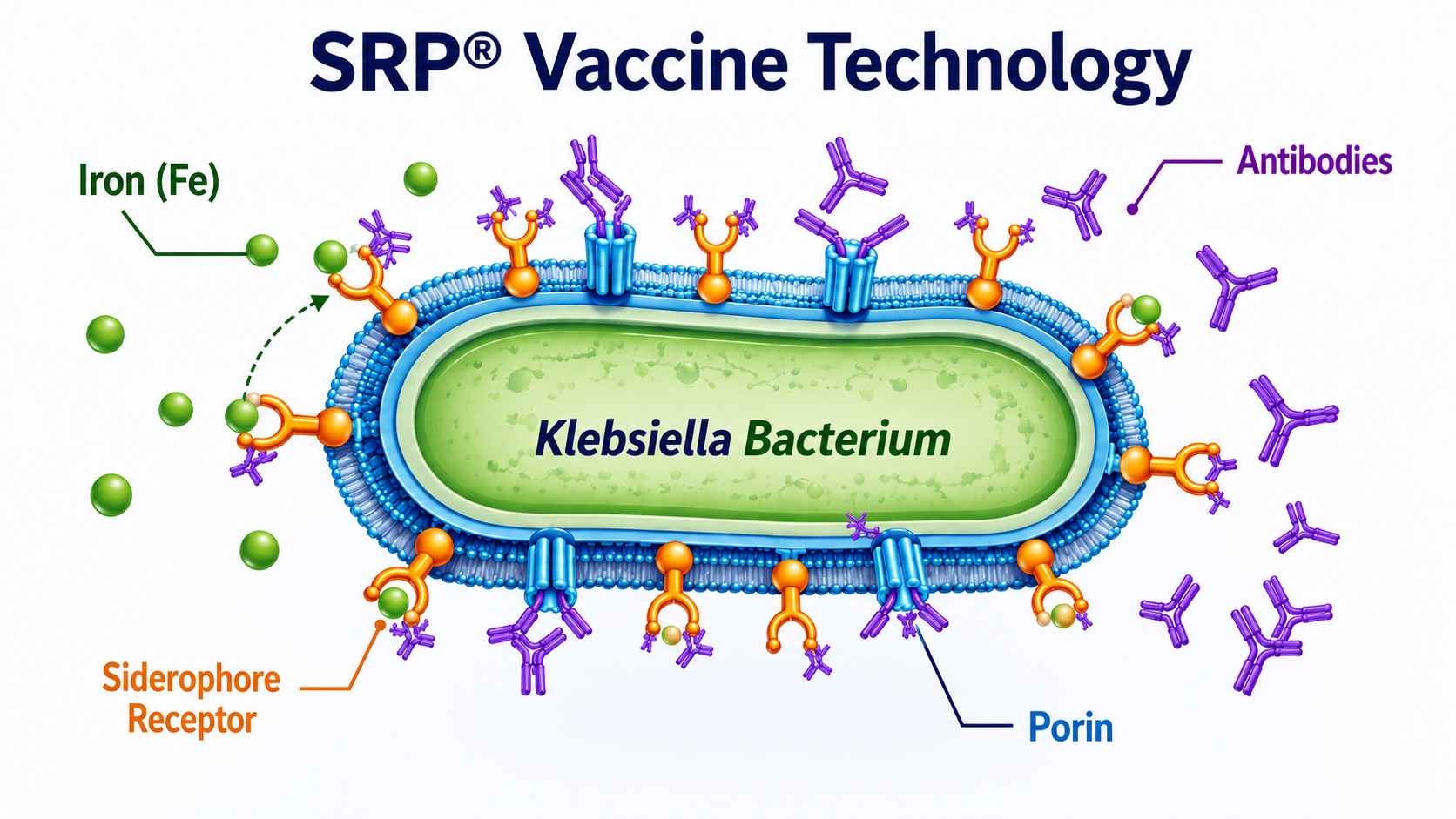
Pathogenic (disease-causing) bacteria require iron for growth and survival. But iron is also essential to animal hosts, which lock away iron using high-affinity soluble proteins such as heme and transferrin. Therefore, in order for bacteria to successfully invade and infect a host, they must utilize their own special iron-gathering protein systems to compete with the host for iron.
Specialized transport proteins called Siderophore Receptors (siderophore is Greek for iron carrier) are located on the outer surface of bacteria. Siderophore receptors belong to a class of tube-shaped proteins called Porins, which transport nutrients through the bacterial cell wall. Together, Siderophore Receptors and Porins (SRP®) can be extracted from bacteria to form a purified protein vaccine.

What is an SRP® vaccine?
It has long been recognized that SRP proteins are highly conserved; in other words, many various bacterial species carry these identical proteins, even though the rest of their exterior structures (LPS, which determines serotype) are unique. This feature makes SRP proteins an attractive target for vaccine development, which has been recognized in scientific literature for many years.
The scientists at Vaxxinova discovered an extraction technique to harvest SRP proteins from commercial scale bacterial fermentations. This made it possible to purify SRP in quantities sufficient for economic vaccine production. Purified SRP can be formulated with many common vaccine adjuvants for administration into a host population by injection.
Active immunization using SRP antigens
There are a number of essential features regarding these specialized transport proteins that open a window of opportunity for disease prevention through active immunization.
- These specialized transport proteins are exposed on the outer membrane of the bacterium, making them susceptible to circulating antibodies produced by the host.
- Active immunization against SRP proteins results in disabling bacterial cell wall receptors required for acquisition of elemental iron, which is an essential bacterial nutrient for metabolism and survival in host animal tissues.
- Antibody mediated response to these surface exposed outer membrane proteins can increase opsonization, that is, increase macrophage activity resulting in increased phagocytosis and induce complement mediated bacterial lysis.
- A number of these porins demonstrate immuno-regulatory activity, acting as T and/or B cell activators which stimulate the synthesis of various cytokines or activate intracellular signaling pathways, thus enhancing the protective efficacy of the vaccine composition.
What is Klebsiella mastitis?
Klebsiella pneumoniae and Klebsiella oxytoca are Gram-negative bacteria. They are found in the environment and can infect cows’ udders and cause severe systemic symptoms. They can be found in wood-based bedding, such as sawdust or wood chips.
Cows can also become carriers of the bacteria in their digestive system. In fact, one study¹ showed that the bacteria was present in 80% of manure samples. It is also increasingly found in milk samples collected during mastitis outbreaks and now accounts for more than 10% of cases worldwide. ²
The effects of Klebsiella mastitis
When a cow is infected, she often develops severe symptoms. These are quite similar to those of other mastitis cases caused by coliforms such as E. coli: fever, loss of appetite, watery milk, and systemic shock. Diagnosis is now straightforward thanks to MALDI-TOF analysis, a method that is now widely used. Treatment involves the use of fluids, anti-inflammatory drugs, and systemic antibiotics.
Despite this, it is not always possible to save the cow. If the cow survives, the affected quarter is often lost, and the animal is culled in more than 50% of cases. ³ Furthermore, the infection often becomes chronic, making it impossible to eliminate the bacteria from the cow’s udder, and the cow becomes a carrier. The animal must therefore be culled. The losses associated with Klebsiella mastitis are thus significant and numerous: loss of milk, treatment costs, reduced production, culling, and mortality.
Preventing infection
Given its economic impact and consequences for animal health, it is important to prevent infection with this bacterium. First, since the bacterium is excreted in feces, it is essential to prevent manure from coming into contact with the udder; therefore, environmental hygiene is a key factor. A milking method that includes pre- and post-milking teat dips can also help prevent new cases from developing. It is also important to identify affected animals and segregate them until they are culled. Furthermore, the use of a teat sealant during dry-off is, once again, highly beneficial.
Finally, vaccination has proven highly effective in reducing the incidence and prevalence of the bacterium. One study³ found that a vaccine using SRP technology was able to reduce prevalence by 71% and the incidence of Klebsiella mastitis cases by 76%, which is significantly better than the protection provided by vaccines targeting the J-5 antigen found in several products.
SRP® technology - Protection that pays!
Discover vaccines with SRP technology that keep cows healthy and productive
You must be logged in to access the page.
1. Munoz M, Ahlström C, Rauch B, Fecal Shedding of Klebsiella pneumoniae by Dairy Cows, Journal of Dairy Science, 89, 3425-3430
2. Song J, Xiang W, Wang Q, Yin J, Tian T, Yang Q, Zhang M, Ge G, Li J, Diao N, Liu F, Shi K, Cai R, Du R, Gong Q. Prevalence and risk factors of Klebsiella spp. in milk samples from dairy cows with mastitis-A global systematic review. Front Vet Sci. 2023 Mar 22;10:1143257. doi: 10.3389/fvets.2023.1143257. PMID: 37035815; PMCID: PMC10073557.
3. Gorden PJ, Kleinhenz MD, Ydstie JA, Brick TA, Slinden LM, Peterson MP, Straub DE, Burkhardt DT. Efficacy of vaccination with a Klebsiella pneumoniae siderophore receptor protein vaccine for reduction of Klebsiella mastitis in lactating cattle. J Dairy Sci. 2018 Nov;101(11):10398-10408. doi: 10.3168/jds.2017-14267. Epub 2018 Sep 7. PMID: 30197148.